Key takeaways
- Perps track the real market like futures do, but never expire, so there are no rollovers.
- An hourly funding payment keeps the perp close to the real price. Day traders barely feel it.
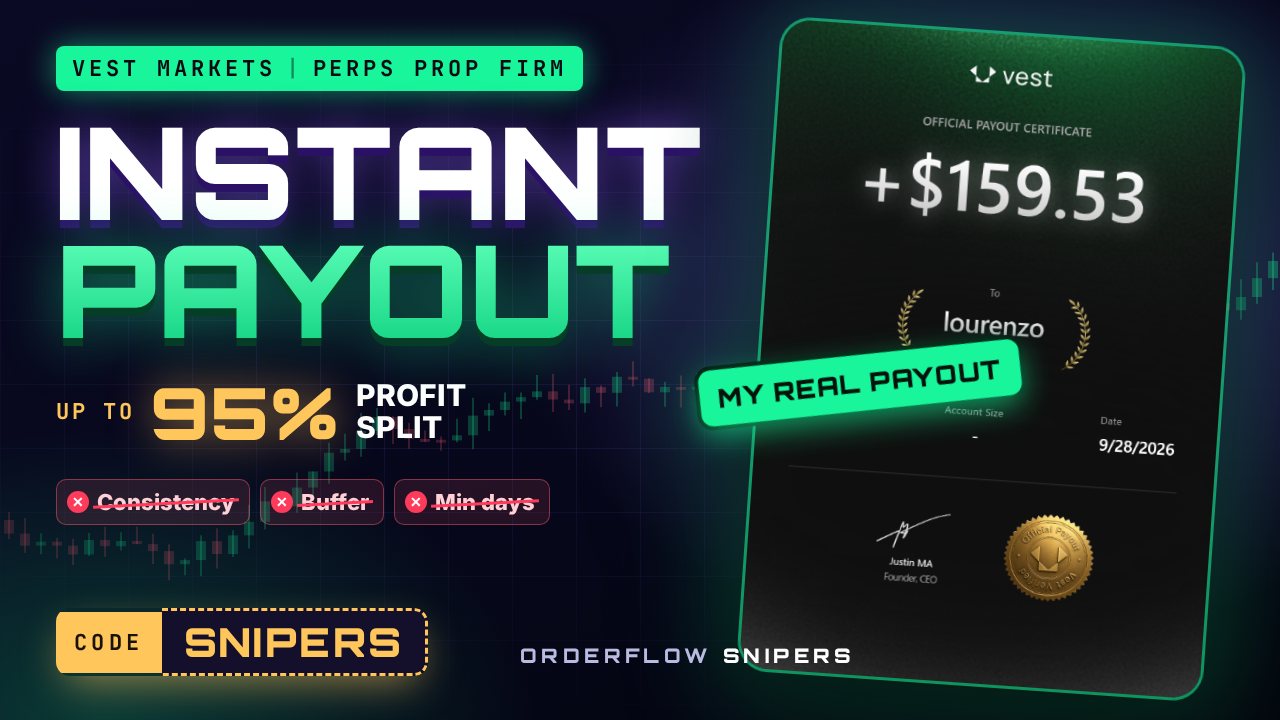
- Perps props like Vest drop the consistency rule, the buffer and the minimum days. Their loss limits are tighter.
- Perps are not CFDs: you trade on an exchange, not against your broker.
Futures prop firms and perps prop firms both fund you to trade the same markets: the Nasdaq, the S&P, gold, oil. The products and the rules around them are different. Here is what changes in practice.
Same markets, different contract
A futures contract like NQ expires every quarter, so you roll from one contract month to the next. A perpetual future ("perp") on the same market never expires. NQ-PERP moves with the Nasdaq-100, so your levels and setups carry over, but there are no rollover gaps and no switching contracts.
Perps settle in USDC and size is flexible, so you can trade smaller than one micro contract.
Funding: the one new cost
With no expiry pulling the price back, perps use a funding rate. Every hour the crowded side pays the other side:
- Perp above the real price: longs pay shorts.
- Perp below the real price: shorts pay longs.
For day traders: in and out within minutes, funding barely touches you.
For swing holds: if you hold with the crowd for hours, the small payments add up and count against your account like any other loss. Hold against the crowd and you get paid instead.

The rules: futures prop vs perps prop
| Rule | Typical futures prop (50K funded) | Vest Markets (perps) |
|---|---|---|
| Days before payout | Often 3 to 14 trading or winning days (TPT: day one) | None, claim on day one |
| Consistency rule | Often 35% to 50%, depending on the plan | None |
| Buffer before withdrawing | About $2,000 to $2,100 | None |
| Payout limits | Caps per request, minimums | Any day, no minimum, no cap |
| Loss limits | Trailing or EOD drawdown, daily limits vary | 3% daily and 6% static drawdown (evaluations) |
Firm-by-firm numbers are in payout rules compared.
The trade-off is clear: a perps prop gives you your money with fewer strings, but the loss limits are tighter. A 6% max drawdown on a $10K account is $600, so position size matters more.
Perps vs CFDs
Forex and CFD prop firms also offer stocks and indices, but a CFD is a contract with your broker at your broker's price. Many CFD brokers take the other side of your trade.
A perp trades on an exchange against other traders and market makers. The market sets the price, and the funding rate keeps it honest. CFDs charge an overnight swap that you almost always pay. With perps, funding can go either way.
FAQ
Is a perp the same as a futures contract?
It tracks the same market and uses leverage like a future, but it never expires and uses an hourly funding payment instead of rollovers.
Do I pay funding if I day trade?
Only on positions that are open when funding is calculated. If you are in and out within minutes, it barely affects you.
Are perps prop firms better than futures prop firms?
They are different. Perps props like Vest have simpler payouts with no consistency rule or buffer, but tighter loss limits. Pick the rules that fit how you trade.
Affiliate disclosure: I earn a commission if you buy through my links or use code SNIPERS, at no extra cost to you. Trading futures and perps involves substantial risk, and leverage magnifies losses. Nothing here is financial advice. Rules and prices change, so confirm them with the firm before you buy. Full disclosures.